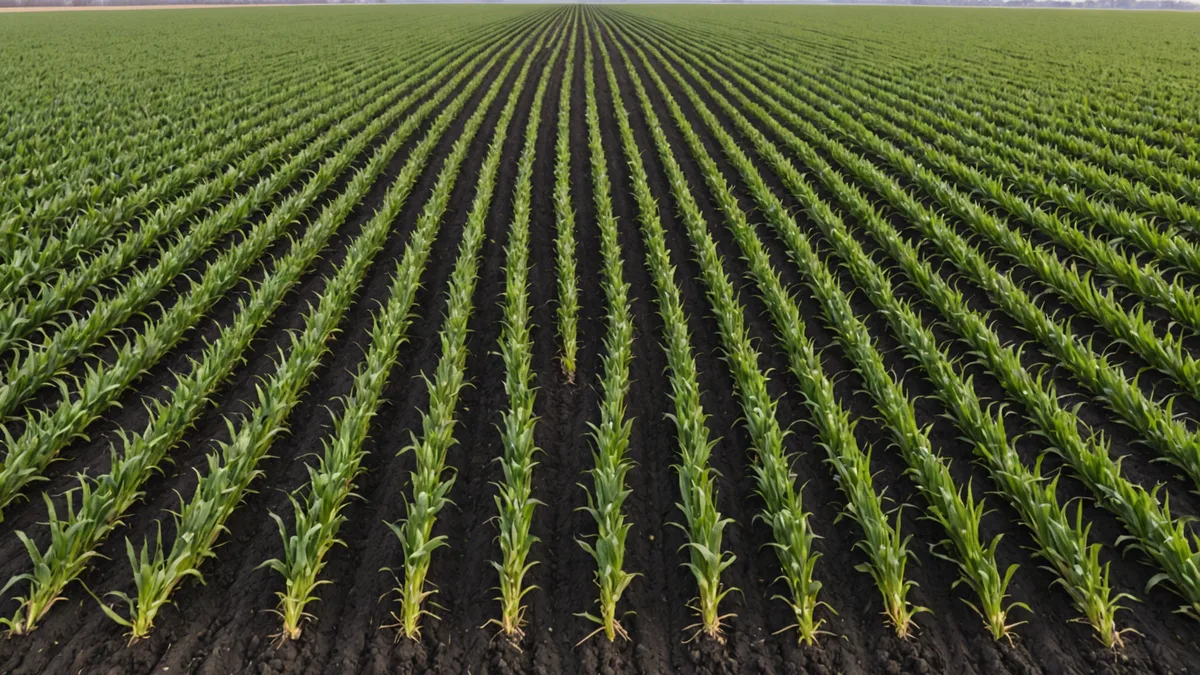
Cover crop adoption in Iowa has accelerated meaningfully over the past several years. USDA NASS data and ISU Extension survey work both show an upward trend in acres planted to cereal rye, oats, radish mixes, and legume covers following corn and soybean harvest. This is a good development agronomically — cover crops reduce erosion, build organic matter, improve soil structure, and in the case of legumes, contribute biologically fixed nitrogen to subsequent crops.
For precision ag workflows built on satellite NDVI analysis, however, cover crops introduce a complication that most platforms don't document clearly: a cereal rye cover crop in good standing in late February or early March generates NDVI values of 0.45–0.65 on Sentinel-2 imagery. That's a strong vegetative signal — and if you're using late winter or early spring satellite imagery as one input layer in your management zone delineation or spring prescription generation, that signal is being read as corn or soybean productivity unless you explicitly account for it.
The Signal Contamination Problem
Management zone delineation using historical NDVI composites typically works by stacking multiple growing-season images and identifying zones of consistent high performance versus consistent low performance over multiple years. The consistency of that pattern across years is what gives the zones agronomic validity — if a zone is consistently low-performing, there's likely a soil-based reason worth addressing.
The problem arises when you incorporate off-season images in your composite. If a platform pulls any available clear-sky images from October through April for its multi-year NDVI composite, and those images capture fields with actively growing cover crops, the cover crop signal inflates the apparent "historical productivity" of those fields — particularly in the zones where the cover crop establishment was best.
Here's the specific failure mode we've observed: cover crops establish better on well-drained, productive soils. The Tama and Muscatine silt loams that drain well and have high OM will grow a lusher stand of cereal rye in fall and spring than the wet Kalona silty clay loam bottomland that stays saturated through much of November and March. So the zones that already show high NDVI during the growing season also show high NDVI during the cover crop window — which reinforces their apparent productivity in a composite.
That reinforcement might seem harmless, but it creates a problem when the composite is used to identify under-performing zones for targeted input increases. If the low-performance signal in the bottomland zone is partially due to poor cover crop establishment rather than or in addition to poor corn productivity, the zone classification may be misleading. You may be applying more N to a zone that is genuinely lower-yielding, but for reasons that have nothing to do with historical nitrogen insufficiency.
How Soilynx Handles Cover Crop Seasons in the NDVI Stack
Our approach to this problem is to flag any field in our system that has cover crop history noted in its management record, and to exclude all imagery acquired between October 15 and May 15 from the growing-season NDVI composite used for zone delineation. We use only imagery acquired between May 15 and October 1 — the window in which signal reflects the actual crop we're trying to manage.
This sounds obvious, but it requires knowing which fields have cover crops and in which years. That information doesn't come from the satellite — it comes from the grower or CCA managing the field. If a producer adopts cover crops mid-stream in a field's data history without telling us, and we have two years of pre-cover-crop imagery and one year of post-cover-crop imagery in the composite, the analysis is still contaminated by the cover crop year unless we identify and exclude those dates.
The practical implication: when onboarding a field with cover crop history, we ask specifically which years had covers and what the termination timing was. That information determines which satellite dates are eligible for inclusion in the baseline productivity composite. It's not a technical complexity — it's a data collection step that takes five minutes in the setup workflow but prevents a classification error that would affect prescription quality for the life of the field's management history in the system.
Cover Crop Termination Timing and the Spring Imagery Gap
A related complication: the spring window between cover crop termination and corn canopy closure is one of the most important periods for satellite-based field scouting, because soil-applied herbicide failure, stand establishment problems, and early nutrient stress all become visible in this window. But in fields where cover crops were terminated late — after May 1 — the terminating biomass creates a spectral artifact that can look like a crop stress signal.
Freshly terminated cereal rye that is desiccating but not yet fully downed shows intermediate NDVI values of 0.3–0.45 — higher than bare soil, lower than healthy growing tissue. In a field where some areas of the cover crop terminated cleanly and others are still partially green, the desiccating patches can appear as low-NDVI "stress zones" in a mid-May satellite pass. An automated system without context about termination timing would flag those as potential issues.
The ground-truth step here is essential: any early-season stress signal in a field with cover crop history should be cross-referenced against known termination date and method (herbicide termination vs. roller-crimper vs. natural winter kill) before it's interpreted as a soil or crop issue. We note the expected termination window in our field record so that early-season imagery is interpreted in context rather than in isolation.
What Cover Crops Do to NDVI-Based Organic Matter Proxies
Some precision ag platforms use multi-year NDVI history as a proxy for soil organic matter trends — reasoning that consistently high-performing zones are building OM through residue return and root biomass. This is a reasonable inference when the NDVI signal reflects only the cash crop. When cover crop signal is included, the correlation breaks down.
We're not saying NDVI-based OM estimation is reliable even in the clean-signal case — it isn't, not at the accuracy level needed for prescription calibration. The validated method for field-specific OM data is still physical soil sampling at appropriate density (2.5-acre grid or EC-zone-based composite sampling). NDVI history can tell you that OM variability probably exists and give you rough zone guidance for where to sample; it cannot replace the sample.
Cover crop fields make this even clearer: the NDVI signal in those fields is a composite of cash crop productivity, cover crop biomass, and termination timing artifacts. Using that composite as a direct OM proxy without understanding what it contains will produce zone boundaries that don't correspond to actual soil properties.
The Upside: Cover Crop Establishment Quality as a Data Layer
The cover crop signal contamination problem has a flip side: if you deliberately capture and interpret cover crop imagery rather than trying to exclude it from the cash crop analysis, you get useful information about cover crop establishment variability across the field.
A November or March NDVI map of a field with cereal rye cover shows where the stand established thickly versus thinly. Poor establishment zones often correspond to wet, poorly drained soils, compacted headland areas, or spots with residue management problems from harvest. That information has management value independent of the cash crop analysis — it tells you where drainage improvement or tillage adjustment might improve the efficacy of your cover crop system.
We've started offering this as an explicit feature: a separate cover crop establishment assessment layer generated from a specifically scheduled late-fall or early-spring image, clearly labeled as cover crop signal rather than included in the cash crop NDVI composite. The key is keeping the two analyses separate — not mixing them — which is precisely the error the field needs you to avoid.