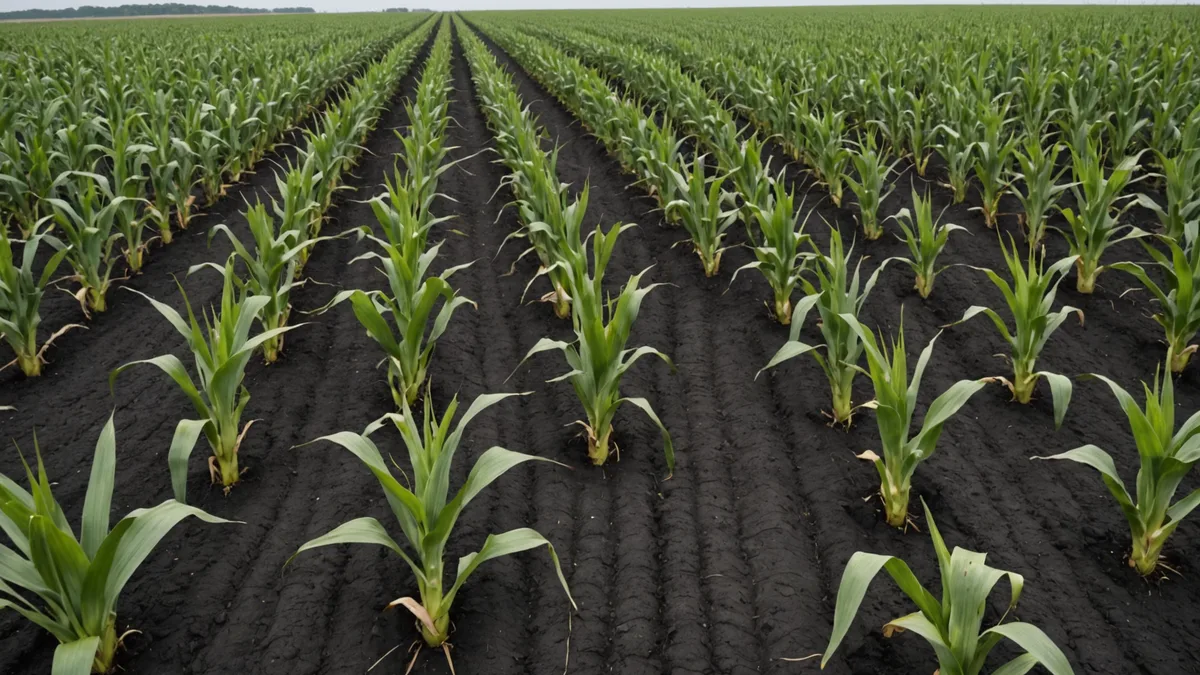
The majority of Iowa corn acres are dryland — no supplemental irrigation, entirely dependent on rainfall and stored soil water. For most of Iowa's agricultural history, that was a reasonable bet: the state averages 33–36 inches of precipitation per year, and well-managed soils with high organic matter and good water-holding capacity provided enough stored moisture to carry corn through most dry spells.
What's changed in recent years is the distribution of that rainfall within the growing season. ISU Extension climate analysis shows increased frequency of extended dry periods in July and August — exactly the window of corn silking and grain fill when water stress causes the most yield damage. It's not that Iowa is getting less rain annually; it's that the timing is less reliably matched to peak corn water demand.
For dryland corn producers, this shift in rainfall distribution makes soil moisture monitoring more valuable than it used to be — not as an irrigation trigger, but as a decision support tool for managing inputs and hybrid selection in fields where different soil zones have meaningfully different water-holding capacities.
What "Water Use Efficiency" Actually Means for Dryland Corn
Water use efficiency (WUE) in a dryland corn context is typically expressed as bushels of corn produced per inch of water consumed (evapotranspiration). Iowa corn under good growing conditions achieves roughly 4.5–6 bu/inch of ET. Under water stress, that efficiency drops as the plant invests in stress responses rather than yield accumulation.
Improving WUE on dryland acres doesn't mean finding more water — it means ensuring the water that does fall or is stored in the soil profile is used as efficiently as possible, and that management decisions are calibrated to the actual water status of the soil rather than a calendar or average rainfall assumption.
The practical levers available to a dryland corn producer for improving WUE are: hybrid selection (drought-tolerant hybrids with better AQUAmax-class traits have measurably better WUE under stress); population management (reducing seeding rates in zones with low available water holding capacity reduces competition for soil moisture in dry years); and nitrogen management (under-nitrified corn cannot take up water efficiently — the two stresses compound).
None of these levers can be applied with precision without zone-specific soil moisture data.
Available Water Holding Capacity: The Number That Matters
Available water holding capacity (AWHC) is the volume of water held between field capacity (the moisture level after drainage slows to negligible) and permanent wilting point (the level at which the plant can no longer extract water). For a Tama silt loam at 4% organic matter, AWHC across a 36-inch profile is typically 5.5–7.0 inches. For an eroded Downs loam with 1.5% OM on a south-facing slope, the same profile might hold only 3.5–4.5 inches of available water.
That 2–3 inch difference in AWHC translates directly to drought resilience. In a July where the field receives 0.8 inches of rain and ET demand is 1.4 inches per week, the low-AWHC zone runs out of extractable water roughly 8–12 days faster than the high-AWHC zone. If that dry period hits during the 10-day silking window, the low-AWHC zone experiences severe yield loss from failed pollination while the high-AWHC zone may be only mildly stressed.
Volumetric water content readings from sensors installed in each zone — paired with AWHC estimates from SSURGO data or laboratory analysis — let you track exactly where each soil zone is in its available water profile in real time. That information changes how you interpret satellite NDVI stress signals in July and what remediation, if any, is appropriate.
A Typical Decision Sequence in a Dry July
Consider a 640-acre corn-soybean operation in Jasper County, Iowa, with three distinct soil zones: a productive Sharpsburg silty clay loam bottom (45% of acres), a Ladoga silt loam midslope (35% of acres), and a Lamoni loam on eroded ridge positions (20% of acres). Sensors installed at two depths in each zone generate hourly VWC readings.
Mid-July, after 22 days without significant rainfall, the Lamoni loam ridge position is reading 0.18 cm³/cm³ at 6 inches and 0.22 cm³/cm³ at 18 inches. The established permanent wilting point for that soil is approximately 0.15 cm³/cm³. That zone has roughly 2–3 days of extractable water remaining at current ET rates before stress becomes severe.
The Sharpsburg bottom is reading 0.31 cm³/cm³ at both depths — well above wilting point, comfortably in the moderate-stress threshold range.
Without the sensor data, a NDVI image from the previous week showing stress on the ridge positions might prompt a reflexive sidedress N application to those zones. With the sensor data, it's clear the ridge stress is water-driven, not nutrient-driven. Applying N to those zones when they're at near-wilting VWC won't move the needle — the plant can't take up N without water. The management response changes: document the stress, note the hybrid performance, and use the data to build a yield stability map for adjusted seeding rates in the next season.
Population Management as a Water Use Tool
Variable-rate seeding specifically targeting water-holding capacity zones is an underutilized precision ag practice in Iowa dryland corn. The agronomic logic is straightforward: seeding rate drives canopy ET demand. At high populations in low-AWHC soils, the crop's water demand can exceed supply in dry years, causing stress that would not occur at lower populations.
ISU Extension research has shown that reducing corn populations from 34,000 to 28,000 seeds/acre in low-AWHC zones reduces water demand sufficiently to maintain acceptable yield in moderate drought years — while the population penalty is small in high-rainfall years because the soil's lower yield potential limits response anyway.
Building this seeding prescription requires knowing which zones have low AWHC — which comes from combining soil sensor VWC history with SSURGO AWHC estimates and, where available, measured soil sample data. Soil moisture sensors don't generate the seeding prescription directly, but they provide the field-specific calibration that validates whether your SSURGO-based zone boundaries actually match the field's real water behavior.
The Limitation of This Approach
We're not suggesting soil moisture sensors are a substitute for rainfall. A severe drought year — defined as more than 3 consecutive weeks below 50% normal July precipitation across the entire field — will stress all zones regardless of how well you've characterized their AWHC. The sensor data tells you the damage is happening and helps you document it for insurance purposes; it doesn't prevent it.
What the sensor network changes is decision quality in moderate dry years — the kind of year where the field has 60–80% of normal July rainfall, distributed unevenly, and some zones cross the stress threshold while others don't. In Iowa, those moderate stress years are more common than either perfect growing seasons or severe droughts, and they're the years where zone-specific management has the most influence on yield outcome.
The producers who get the most value from soil moisture monitoring in dryland corn contexts are those farming fields with high AWHC variability — where the difference between the best and worst water-holding zones spans more than 2 inches across the profile. That description covers a large share of central and south-central Iowa ground with mixed soil series on rolling terrain, and it's the population of fields where the data we generate has the most agronomic and economic relevance.