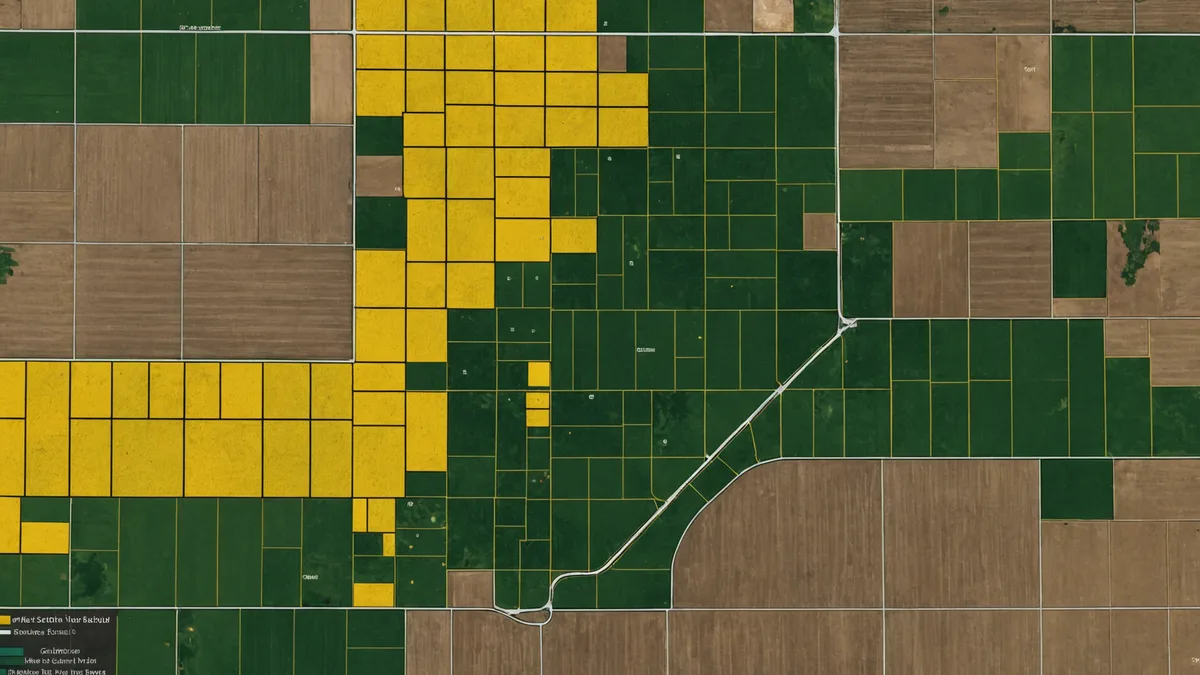
Grid sampling at 2.5-acre density has been the precision agriculture standard for soil phosphorus and potassium testing for a good reason: it captures spatial variability at a resolution that supports meaningful prescription development. It also costs $8-15 per sample including lab fees, which on a 200-acre field with 2.5-acre grids means 80 samples and $640-1,200 per sampling event. On a 4-year sampling rotation, that's $160-300 per year just to understand where your P and K are.
Zone-based sampling — using spatially defined management zones rather than a regular grid — can reduce that sample count by 40-60% on most Midwestern fields without meaningfully compromising the quality of the prescriptions you generate from the data. The prerequisite is having good management zones. If your zones are accurate — built from multiple lines of evidence that include yield history, soil EC, and satellite imagery — then collecting 4-6 cores per zone and compositing them to a single sample per zone captures the relevant variability at lower cost than a regular grid.
This post explains when zone sampling is a defensible replacement for grid sampling, how to do it in a way that doesn't sacrifice prescription accuracy, and where the approach has real limitations you should understand before switching.
The statistical case for zone sampling
Grid sampling assumes that spatial variability in P and K is random or gradual and that a regular sample spacing will characterize it adequately. That assumption is only approximately true. Soil P and K actually follow structured spatial patterns that correlate strongly with soil texture gradients, organic matter distributions, and historical management zones. In a field where high-CEC silt loam zones have been building P for 20 years under heavier application rates, and low-CEC coarse-textured zones have been depleting under high removal by high-yield corn, the P variability is structured around those soil landscape features — not randomly distributed across a grid.
When the underlying variability has structure that corresponds to identifiable soil zones, sampling within zones and compositing is more statistically efficient than random grid sampling. You're concentrating your sampling effort to capture the between-zone differences that actually matter for prescriptions, rather than spending sampling density on within-zone variability that doesn't change the application rate.
The critical qualifier: this argument only holds if your zones accurately reflect the P and K variability gradient. Zones built exclusively from yield data — without soil texture or EC information — may correlate well with nutrient differences in some fields and poorly in others. Zones built from multiple data layers are more likely to track the nutrient variability you care about.
Building zones suitable for zone sampling
For zone sampling to produce defensible prescription data, the zones need to meet a few requirements that aren't automatically met by all zone-building approaches.
Zones should be built from soil-physical data, not just crop response data. Soil electrical conductivity is the most cost-effective single-pass soil physical characterization tool available. A shallow EC map (0-12 inches) reflects clay content and soil moisture, both of which correlate well with CEC and nutrient-holding capacity. A deep EC map (0-36 inches) adds subsoil texture information. Either depth provides spatial structure that helps identify zones where P and K behaviors will be fundamentally different.
Satellite-derived bare soil reflectance from early spring or late fall (before or after crop cover) adds complementary information. Soil organic matter content influences reflectance in the visible spectrum. Topographic position — high knolls vs. footslopes vs. depressional areas — shows up in both bare soil reflectance and in yield history. These landscape signatures persist across seasons and correlate with long-term nutrient dynamics in ways that single-year crop response maps don't.
Zones should be large enough to support compositing. The standard zone sampling protocol calls for collecting 8-12 soil cores per zone, composited to a single sample. For compositing to be meaningful, the zone needs to cover at least 8-10 acres. Sub-5-acre zones are too small to composite reliably — the within-zone variability at that scale starts to exceed the between-zone differences you're trying to characterize. When we build zones for zone sampling, we set a minimum zone size of 10-12 acres and merge smaller adjacent zones with similar EC signatures into a single sampling unit.
Zones should be validated against prior soil test history when available. If you have 2.5-acre grid samples from a previous sampling event, you can evaluate whether your proposed zones capture the P and K variability at the field scale. Calculate the variance in P and K explained by zone membership versus residual within-zone variance. If zone membership explains less than 60% of total field-scale P variance, your zones are not aligned with the P spatial pattern and zone sampling from those zones will produce noisier data than the grid.
Sampling protocol for zone-based P and K
Once your zones are defined and verified, the collection protocol matters for result quality.
Sample depth consistency is the most commonly overlooked issue. P and K recommendations from ISU Extension (and most Midwest university guidelines) are calibrated to 0-6 inch samples for P and K, and 0-8 inch for pH. Variable sampling depth introduces more error than almost any other factor. Train whoever is pulling cores to use a consistent target depth, and calibrate your soil probe against a marked rod before starting. A half-inch variation in sampling depth across 8-12 cores composited together won't break an analysis, but consistent bias toward 4-inch instead of 6-inch depth will systematically bias your P results upward (since P is surface-concentrated in Midwest no-till and strip-till systems).
Core distribution within a zone should avoid obvious outlier areas within the zone — field roads, low spots that hold standing water, headland rows with known application overlap issues. These areas don't represent the zone's characteristic soil chemistry and will pull the composite value toward an unrepresentative reading. We flag these exclusion areas in the zone sampling plan we generate in Soilynx before the sampling event.
Timing consistency matters when comparing zone samples across years. Soil P and K levels fluctuate seasonally — P is higher in fall after residue decomposition contributes soluble P, K is higher in spring when freeze-thaw cycles release K from clay particles. Ideally, re-sample in the same season as the initial baseline to maintain comparability. Fall post-harvest sampling is most common in the Midwest and gives you data in time for winter prescription planning.
When grid sampling is still the right choice
We're not saying zone sampling is appropriate for every field or every situation. There are cases where the structure-based argument for zone sampling breaks down and grid sampling remains the better option.
Fields with low spatial variability in soil texture don't benefit much from zone-based sampling. A field with uniform silt loam texture across 95% of its area, consistent slope and drainage, and low historical yield variation doesn't have meaningful P and K zones to sample. A single whole-field composite sample — or a 10-acre grid that's sparse but adequate for a low-variability field — is a more cost-effective choice than elaborate zone construction and zone-based sampling.
Fields with severe historical management irregularity — multiple ownership changes, periods of no soil testing, areas that received heavy lime or manure applications at unknown rates — need grid sampling to establish a baseline. Zone sampling assumes you have enough prior knowledge to identify meaningful zones. Without a baseline, you're making zone assumptions without validation, and a first-cycle soil test program is better served by denser regular grids that document the starting point without imposing a zone structure you haven't verified.
Fields in the first year with a new precision ag provider have the same issue. Until you've run a cycle with zone-validated sampling and verified that the zones track the nutrient variability, you're extrapolating from zone structure data (EC, satellite) to nutrient outcomes. That extrapolation is usually directionally correct, but the first cycle should include enough grid samples alongside the zone samples to validate the correspondence before committing fully to zone-only sampling.
The cost math
A 160-acre field at 2.5-acre grid density requires 64 samples. At $10 per sample including lab, that's $640. On a 4-year cycle, annual cost is $160 for that field.
The same field with 4 well-defined zones (40 acres average) requires 4 composite samples, each composited from 10 cores. Sample processing cost is identical. Collection time is similar — you're pulling the same number of individual cores (40 vs. 64) but compositing them differently. Lab cost drops to $40 per sampling event, or $10 per year on a 4-year cycle. The per-field savings are real, and they accumulate to something meaningful across a full farm operation.
The savings argument is most compelling for growers managing 1,000+ acres across multiple fields, where the per-field savings multiply. For a 40-acre field, the cost difference between 16 grid samples and 3 zone samples may not justify the effort of zone construction if the field is relatively uniform. Zone sampling investments make the most sense in larger, higher-variability fields where the zone structure is likely to be stable across multiple sampling cycles.
The goal is not to minimize sampling effort for its own sake. It's to allocate sampling resources where they capture meaningful variability and reduce them where they don't. A well-designed zone sampling program does that — and leaves budget for more frequent sampling cycles than many growers run on a strict grid program, which may be the bigger agronomic benefit in the long run.