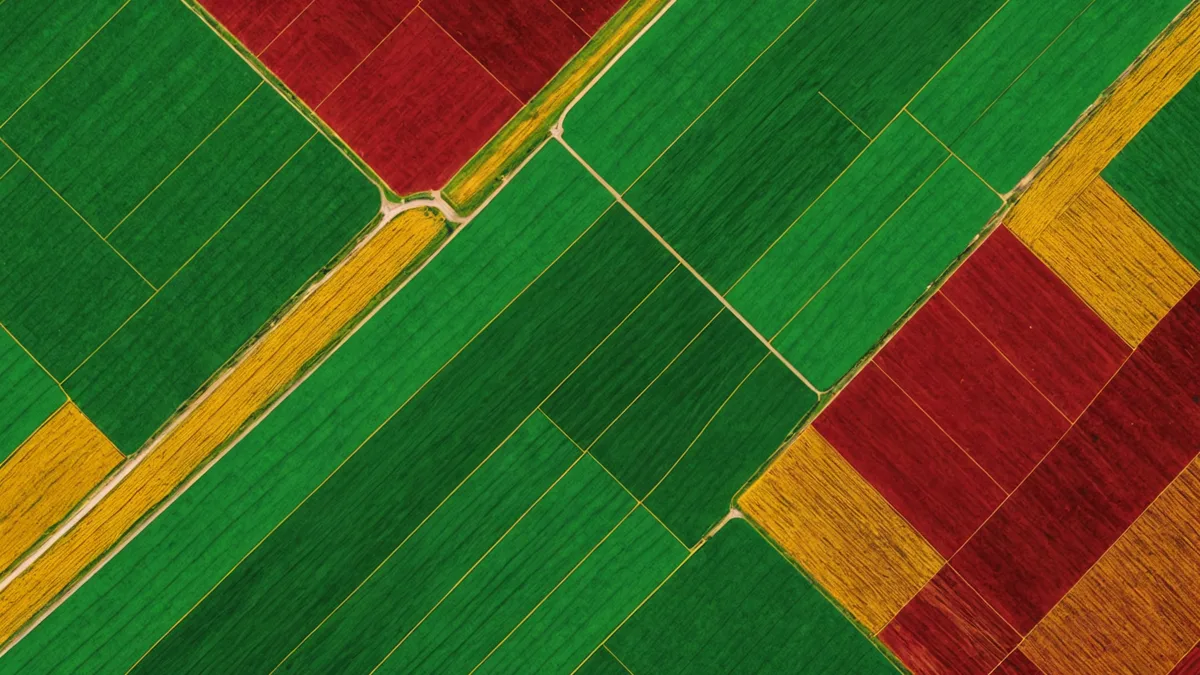
Every summer, Priya gets calls from CCAs and producers who have a NDVI map in front of them and a window of maybe four days to decide whether to make an emergency sidedress application. The satellite image shows red. The question is always: what kind of red?
NDVI — the Normalized Difference Vegetation Index — is derived from the ratio of near-infrared and red reflectance. Healthy green tissue absorbs red light and reflects NIR strongly. Stressed, sparse, or absent vegetation does the opposite. On a standard NDVI color ramp, dark green means high canopy density and vigor; red or brown means low values. But "low NDVI" covers a remarkable range of conditions, and treating all red pixels the same way is how you end up with a prescription that wastes money or misses the actual problem.
The NDVI Scale and What It Actually Measures
NDVI runs from -1 to +1. In practice, healthy closed-canopy corn at V8–V12 in Iowa will typically range from 0.7 to 0.85 on Sentinel-2 Band 4/8 imagery at 10-meter resolution. Values below 0.5 during the growing season are a signal worth investigating. Values below 0.35 in mid-July corn indicate significant canopy gap, heavy stress, or both.
What NDVI cannot tell you on its own: the cause. Low NDVI is a symptom. It's the satellite equivalent of seeing yellowing leaves from a plane — you know something is wrong, but you don't yet know what.
The diagnostic step that most precision ag workflows skip is cross-referencing the NDVI image against other spectral bands and against the field's spatial context. That cross-reference is where stress type disambiguation happens.
Nitrogen Stress vs. Water Stress: The Key Distinction
Nitrogen deficiency and water stress can both produce low NDVI values in corn. They look different in the field — N stress produces the classic firing pattern from leaf tip to base on lower leaves, while water stress produces leaf rolling and overall canopy compression. But from satellite altitude, their NDVI signature can overlap considerably, especially in Sentinel-2's 10-meter pixels, where you're averaging signal across a 10m x 10m patch.
The distinguishing data layer is the red-edge band. Sentinel-2 provides three red-edge bands (B5, B6, B7) centered around 705, 740, and 783 nm. The Red-Edge Chlorophyll Index (red-edge CI) — calculated as (B7/B5) - 1 — is more sensitive to chlorophyll concentration than NDVI and less confounded by canopy structure. When chlorophyll is depleted due to N deficiency, red-edge CI drops sharply even before NDVI shows a major decline.
In practice: if you have a red zone on your NDVI map and the red-edge CI for that zone is also markedly lower than surrounding areas, N deficiency is a reasonable hypothesis. If NDVI is low but red-edge CI is relatively intact — meaning the tissue that is present is green and chlorophyll-dense — you're more likely looking at reduced canopy density from water stress causing leaf roll and smaller canopy footprint rather than actual chlorophyll depletion.
We're not saying red-edge CI definitively separates N stress from water stress in every case — it doesn't. But it narrows the diagnostic space before you commit to a sidedress application.
The Spatial Pattern as a Diagnostic Tool
Beyond spectral band analysis, the spatial shape of a stress signature tells you a great deal about probable cause.
Nitrogen deficiency in corn tends to track soil organic matter gradients — it appears on sandy, low-OM knolls; on eroded hilltops where the dark, OM-rich topsoil is thin; or in low spots where waterlogging early in the season caused N loss through denitrification. When you overlay an NDVI stress zone on a soil EC map or an OM layer derived from historical topsoil sampling, and the spatial correlation is high, that's strong circumstantial evidence for a soil-driven nutrient issue.
Water stress has a different spatial signature. In dryland Iowa corn, water stress tends to appear most severely on south-facing slopes and raised, well-drained positions — because those positions drain faster and have less soil water holding capacity at critical periods. The same knolls that look stressed in NDVI during a dry July often recover in August if rainfall returns, without any nutrient intervention.
A useful diagnostic exercise: pull your NDVI image from a high-stress day in July and compare it to a multiyear NDVI composite from wetter years. If the low-value patches occupy the same locations year after year, you have a management zone problem that warrants deeper soil data collection. If the low-value areas shift year to year depending on rainfall distribution, you're looking at a primarily water-driven response — and the prescription lever to pull is moisture management, not additional nitrogen.
Timing Matters More Than Most People Realize
NDVI values for corn shift dramatically across vegetative stages, and the absolute values are not directly comparable across dates. An NDVI of 0.55 in V5 corn is normal — the canopy hasn't closed. The same value at V10 indicates significant stress relative to the growth stage.
Sentinel-2's 10-day revisit cycle (5-day with both satellites) means you're typically working with images that are 5 to 20 days old by the time cloud cover clears and a usable image lands. This matters because corn stress responses change quickly. A V4 image showing slight stress may be irrelevant by the time it's available for V8 action. This is why we align satellite acquisition scheduling to target the V4–V5 window specifically — that's the window where sidedress decisions are still actionable and stress signals from the early vegetative period are predictive of what will compound through pollination if unaddressed.
GNDVI and Its Use for Early-Season Detection
The Green NDVI (GNDVI) — using green reflectance (Sentinel-2 B3) in place of red — is more sensitive to low-chlorophyll conditions and performs better early in the season when canopy cover is incomplete. In sparse-canopy conditions below V6, NDVI is heavily confounded by soil background reflectance, which pulls values down regardless of plant health. GNDVI has a lower sensitivity to soil background, making it more reliable for detecting actual chlorophyll-based stress in young corn.
We use GNDVI as a complement to NDVI in early-season scouting passes, particularly in years where slow emergence has left significant bare soil between rows at the time of the first usable satellite image. The combination of GNDVI, red-edge CI, and the field's spatial context — checked against soil EC and the 5-year NDVI history — gives a much stronger diagnostic signal than NDVI alone.
How to Use This in Practice Before Writing a Prescription
When a CCA in east-central Iowa sends us a satellite image and asks whether the red patches need sidedress N, our diagnostic checklist before generating a prescription recommendation looks like this:
First, check the date the image was captured and the current growth stage. If the image is more than 12 days old during rapid vegetative growth, treat it as historical context rather than a current prescription trigger.
Second, pull the red-edge CI and GNDVI layers for the same image date. If both are low in the stress zone, chlorophyll depletion is implicated. If only NDVI is low, look at canopy structure causes first.
Third, compare the stress zone geometry to the soil EC or OM layer. Correlation = likely soil-driven, year-consistent nutrient issue. No correlation = check recent rainfall records and slope position.
Fourth, go walk the field. This is not a step you skip. Satellite data tells you where to look and what to look for. Ground-truth confirmation — looking at leaf symptoms, pulling a plant, checking root development — is what moves a hypothesis into a decision.
Variable-rate prescription generation from NDVI maps produces real value when the diagnostic reasoning behind the map is sound. Using NDVI as a single metric to trigger automatic applications without the cross-band and spatial context review described here will generate some correct decisions and some expensive mistakes — and the mistakes will tend to cluster in exactly the fields where the soil variability is highest and the ROI opportunity is greatest. That's not a trade-off worth making.