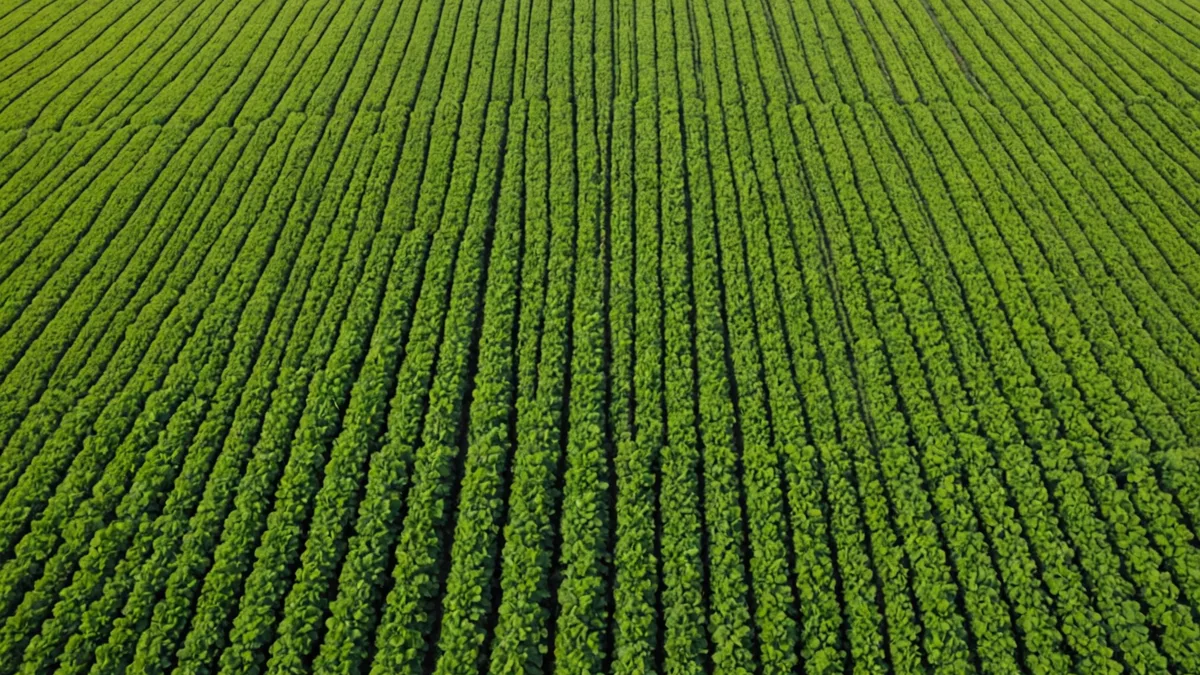
The agronomic discussion around variable-rate seeding has historically been dominated by corn. Corn responds predictably to plant population density, has well-documented yield-population response curves by soil type, and the ROI math is clean enough that seed companies got behind the concept early. Soybeans got less attention — partly because soybean yield response to plant population is genuinely more forgiving, and partly because the conversation never got as systematically organized.
But soybean VRS has a real case, particularly in Iowa fields where soil variability is high. The key is building the right yield zones first. If your zones don't reflect the underlying soil constraints that actually drive soybean yield differences, adjusting seeding rate across them won't do much. This post describes how we think about zone construction for soybean variable-rate prescriptions.
Why soybeans respond to variable-rate seeding differently than corn
Soybeans have a compensatory branching mechanism. A plant at 100,000 seeds per acre in a high-productivity zone will produce more branches and pods than a plant at 140,000 seeds per acre. This means the yield curve is considerably flatter across a range of seeding rates compared to corn. The practical implication: you're not going to see dramatic yield gains by increasing population in your best zones. The case for VRS in soybeans is primarily cost savings in lower-productivity areas, not yield maximization in premium zones.
Consider a 160-acre field in Muscatine County, Iowa with a well-documented wet-corner drainage problem. About 30 acres of that field has heavy clay soil with poor internal drainage — CEC over 28 meq/100g, clay content above 42%, tile drainage that doesn't fully keep pace with a 4-inch rain event. Soybean populations of 140,000+ in that zone in a wet year result in significant seedling disease pressure (Pythium, Phytophthora) without meaningful yield benefit compared to a 110,000 population that gives better air circulation and root establishment. The seed cost difference on 30 acres at $50 per 140K unit: roughly $300-400 per season. Over a 5-year rotation, that adds up against the cost of generating the prescription.
That's the soybean VRS value proposition: cost savings in constrained zones, not yield bumps in high-potential zones. Your agronomist may not say this explicitly, but the math is usually about reducing over-seeding in your worst-performing areas.
The data inputs that matter for zone construction
We use three primary data layers to build soybean yield management zones: soil electrical conductivity (EC), multi-year yield data, and soil texture from either lab samples or Web Soil Survey (SSURGO) polygon data.
Soil EC at shallow depth (0-12 inch) correlates primarily to clay content and soil moisture in the Midwest. High EC readings track well with fine-textured, poorly drained zones. Deep EC (0-36 inch) adds information about subsoil texture — useful for distinguishing shallow restrictive layers from uniform heavy clay profiles. We run both depths when we're setting up a new field for VRS work, then use the EC map as the structural framework for zone boundaries.
Yield data serves as validation and refinement. If your shallow EC map says a zone is high-productivity and your 4-year corn yield composite says it consistently yields 185+ bu/acre, those signals align and you have high confidence in zone placement. If your EC map says a zone is moderate and the yield data shows it as consistently low, you have a secondary constraint (tile drainage gap, isolated compaction layer, etc.) that you need to understand before adjusting seeding rates.
We're not saying EC alone is sufficient to build good management zones — it isn't. EC without yield history validation produces zones that are geographically sensible but agronomically uncertain. The combination holds up better than either layer alone.
Soil texture percentages — specifically sand/silt/clay ratios and organic matter content — matter for calibrating soybean population targets. High sand content (above 45% sand) typically means lower water-holding capacity, faster drainage, and lower yield potential for soybeans unless irrigation is available. Zones with coarse texture warrant lower populations for different reasons than heavy clay zones: it's about moisture limitations rather than drainage problems, but the directional recommendation (lower population) is often the same.
Building the zones: the clustering approach
For a field with available EC data, 3+ years of yield history, and soil sample data, we typically run a k-means clustering routine on normalized inputs to produce 3-5 management zones. The number of zones depends on field size and data quality — a 100-acre field with clean data can usually support 4 zones. A 40-acre field with limited yield history might be better served by 2-3.
We evaluate zone stability across at least 3 cropping years before finalizing population targets. Zones that shift significantly year-to-year in yield rank are likely responding to weather patterns rather than stable soil constraints. Prescribing different populations to weather-driven zones doesn't make agronomic sense — you want zones that reflect consistent soil limitations, not variable precipitation response.
Yield stability index is the metric we use to filter this. A zone that ranks in the bottom quartile for soybean yield in 4 out of 5 years is a stable low-performance zone and is a legitimate candidate for reduced seeding rates. A zone that alternates between high and low performance based on summer rainfall is not a stable zone and shouldn't drive population adjustments.
Population targets by zone type
Soybean seeding rate recommendations vary by seed company, maturity group, and soil type. ISU Extension guidelines generally anchor around 140,000 seeds per acre for Iowa conditions, with adjustments downward for good stands and lower-stress soils, and upward for fields with known seedbed or disease pressure.
For soybean VRS specifically, a practical range we've found defensible for Iowa row-crop fields with established management zones:
High-productivity zones (well-drained, clay loam to silt loam, strong yield history, good CEC): 130,000-140,000 seeds per acre. Soybeans in these zones branch efficiently. Higher populations don't move the yield needle meaningfully and increase input cost.
Moderate-productivity zones (variable drainage, mixed texture, some yield history volatility): 135,000-145,000 seeds per acre. These are the zones where you're not taking risk by staying near the standard recommendation.
Low-productivity zones — wet/poorly drained heavy clay: 110,000-125,000 seeds per acre. Less competition, better air movement, reduced disease pressure from Phytophthora sojae. These zones rarely respond to higher populations; they're limited by drainage and soil biology, not plant density.
Low-productivity zones — sandy/coarse texture, drought-prone: 110,000-130,000 seeds per acre. Lower moisture retention means you want efficient use of available soil water. Higher populations in drought-prone coarse-textured zones can actually pull available soil water faster early in the season, leading to worse outcomes during an August dry period.
What to verify before writing the prescription
Before you generate and load a soybean VRS prescription, check three things. First, verify that your zone boundaries don't cut across planted-field-width increments in a way that creates tiny prescription slivers — any zone segment narrower than your planter's row-unit width will cause the applicator to interpolate rather than properly switch rates. This is a common geometry problem that shows up in fields with curved zone boundaries.
Second, confirm your yield data is properly georeferenced and cleaned. Harvest head lift/lower zones at field edges frequently produce outlier yield values that distort zone analysis. Standard harvest data cleaning removes speeds below 2 mph and above 8 mph and excludes the first and last 30 feet of each pass. If your yield data hasn't been through that cleaning step, zone analysis will over-weight the boundary noise.
Third, check that your seeding rate targets make sense against your seed test germination percentage. The prescription rates we describe above are seeds per acre — your actual planted rate needs to account for seed germination percentage from the lot's test tag. A bag with 92% germination at a target of 130,000 seeds per acre means setting the controller to approximately 141,000 seeds per acre to hit target stand.
Soybean VRS pays back in fields with documented, stable soil variability. If your field history shows consistent yield differences of 8+ bu/acre between your best and worst zones, the zone-building work is worth doing. If variability is low and driven mainly by weather, you'll spend more time building the prescription than you'll save on seed.